
TSF-AV · Enterprise Technical Rider Manual
Large-Scale AV Technical Rider Guide: Engineering Fail-Safe Corporate Summits
The definitive equipment specification and acoustic calculation manual for technical directors and corporate producers deploying d&b line arrays, P2.6 ultra-HD LED walls, Barco 4K matrix switching, and isolated power across Hyderabad.
Section 01 · Electro-Acoustic Engineering
Concert-Grade Sound for Corporate Summits: The Physics of Intelligibility
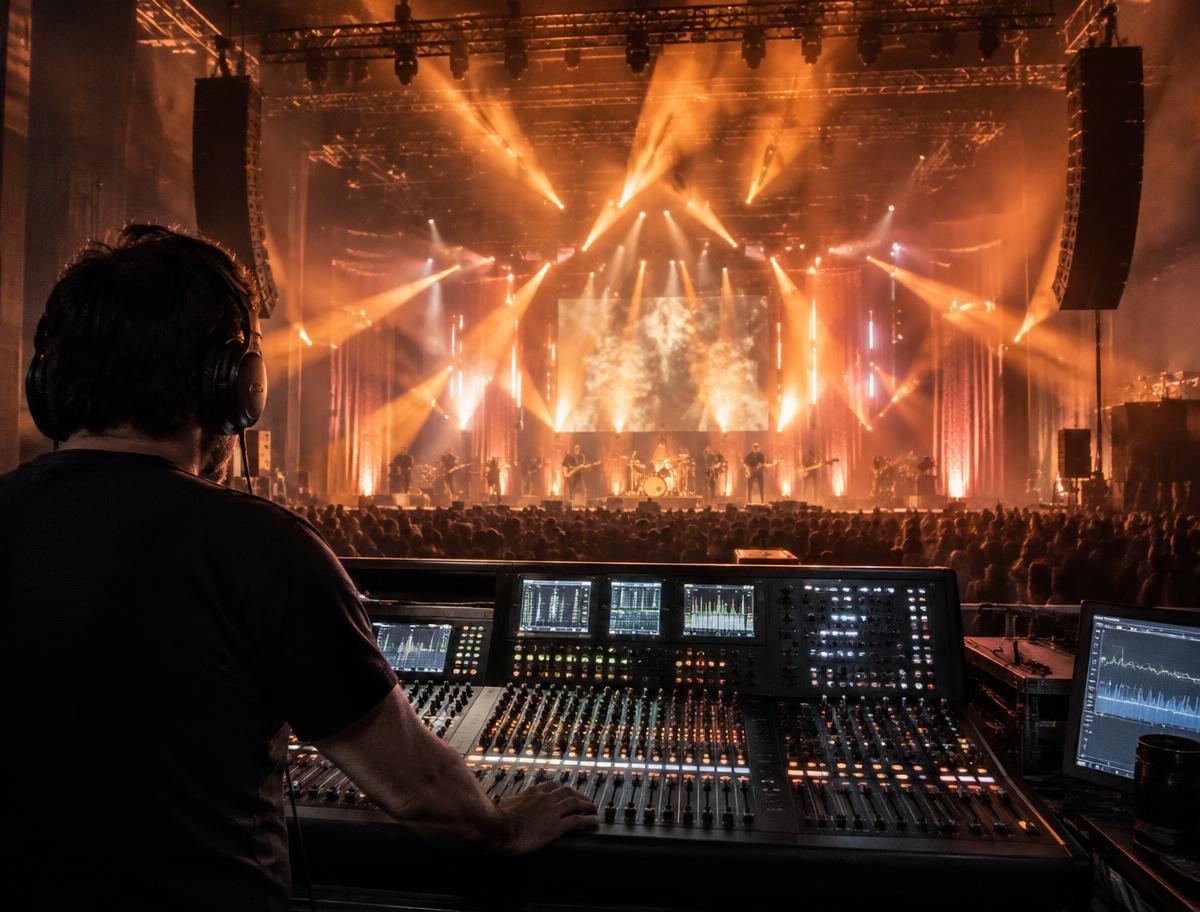
Corporate audio operates under a fundamental paradox: plenary speeches demand absolute speech intelligibility (Speech Transmission Index STI > 0.65) with minimal room reverberation, while award reveals and executive walk-in stings require 105 dB dynamic concert punch without distortion or harshness.
Standard hotel PA systems and conventional point-source loudspeakers obey the inverse square law ($1/r^2$), losing 6 dB of Sound Pressure Level (SPL) every time the distance doubles. To reach the 30th row, point sources must be driven to deafening levels in front, causing feedback on CEO lectern microphones and high room excitation off reflective ballroom walls.
🔊 The Line Array Advantage: Cylindrical Wavefront Physics
A line array of acoustically coupled drivers forms a coherent cylindrical wavefront in the near field. This reduces sound attenuation to only 3 dB per distance doubling ($1/r$). The result: delegates in Row 1 and delegates in Row 40 experience virtually identical vocal clarity without front-row ear fatigue.
Cardioid Subwoofer Directivity: Low-frequency stage rumble is the primary cause of muddy corporate audio. TSF-AV deploys d&b V-SUBs featuring patented passive cardioid technology (an 18" forward-facing driver and a 12" rear-facing driver operating in an integrated bass-reflex chamber). This cancels out 15 to 20 dB of rearward bass energy, creating a whisper-quiet stage environment where sensitive headworn DPA lapel microphones can be pushed for high gain before feedback.
TSF-AV Audio Specification Standard
Digital multi-track recording & isolated press feeds
Section 02 · Visual Display Physics
P2.6 LED Wall Pixel Pitch Math, Aspect Ratios & 4K Processing
Specifying LED display screens for corporate keynotes requires rigorous optical mathematics. Specifying an overly coarse pixel pitch causes visible pixel grid dots (screen-door effect) and severe camera sensor moiré patterns, while an improperly mapped canvas causes blurry, stretched corporate typography.
| Pixel Pitch | Cabinet Resolution (500x500mm) | Min Viewing Distance | Refresh Rate & Driver | Best Use Case |
|---|---|---|---|---|
| P1.9 mmUltra-Fine Pitch | 256 × 256 pixels | 1.9 meters (6.2 ft) | 3840Hz · Macroblock 5359 | Boardroom command centers, luxury VIP car reveals, studio close-up broadcast. |
| P2.6 mm (TSF-AV Gold Standard)Enterprise Plenary Default | 192 × 192 pixels | 2.6 meters (8.5 ft) | 3840Hz · Black SMD 1515 | High-stakes corporate plenaries, AGMs, summits, 4K multi-window presentations. |
| P3.9 mmMid-Range Commercial | 128 × 128 pixels | 3.9 meters (12.8 ft) | 1920Hz / 3840Hz | Exhibition hall perimeter banners, outdoor daytime pavilions, concert backdrop delay walls. |
Worked Example: 14-Meter Wide Plenary Canvas Math
Let's engineer an ultra-wide panoramic backdrop screen measuring 14.0 meters wide by 4.5 meters high (3.11:1 aspect ratio) for an enterprise summit in HICC:
- Physical Cabinet Count: 28 cabinets wide × 9 cabinets high = 252 total cabinets (500mm × 500mm format).
- Native Pixel Matrix: (28 × 192 px) × (9 × 192 px) = 5,376 × 1,728 native pixels.
- Total Raster Pixel Load: 9,289,728 total pixels.
Processing & Distribution Architecture:
Section 03 · Venue Realities
Why In-House Hotel AV Fails Enterprise Summits (And How We Fix It)
The Hollow Echo Chamber
The Problem: In-house ceiling speakers bounce audio off banquet carpets and chandeliers, causing a 400ms reverberant decay where speech turns into unintelligible mud.
TSF-AV Fix: Directional d&b line arrays flown with mechanical down-tilt, directing acoustic energy strictly into delegate seating and keeping it off reflective ceilings.
Washed-Out 16:9 Projectors
The Problem: Aging 6,000-lumen lamp projectors mounted to hotel ceilings get completely washed out the moment ambient stage lighting or chandelier washes are turned on.
TSF-AV Fix: High-contrast P2.6 Black SMD LED walls delivering 1,000+ nits brightness and 5000:1 contrast, maintaining razor-sharp clarity under full stage illumination.
Shared Circuit Breaker Trips
The Problem: Hotel ballrooms frequently share electrical sub-panels with banquet kitchens. When warming ovens fire up during tea break, the AV circuit trips instantly.
TSF-AV Fix: Dedicated isolated mobile silent diesel generator (125kVA – 250kVA) powering all technical production entirely independent of venue electrical load.
Section 04 · Power & Redundancy
Three-Phase Balancing, Harmonic Distortion & Clean Earth Grounding
More corporate AV failures trace back to dirty electrical power than all hardware malfunctions combined. LED video screens use switch-mode power supplies that draw current in short, high-magnitude pulses, creating heavy triplen harmonics (3rd, 9th, 15th harmonic orders).
In unbalanced systems, these harmonics do not cancel out—they accumulate in the neutral conductor, causing severe neutral wire overheating and voltage fluctuation that can crash digital consoles mid-event.
The TSF-AV Clean Power Protocol:
- Three-Phase Balancing: We balance LED tile banks, audio amplifiers, and moving lighting fixtures across L1 (Red), L2 (Yellow), and L3 (Blue) phases within a strict ±8% balance margin.
- Clean Earthing Potential: We require an independent copper earthing pit with Earth-to-Neutral potential < 2.0 Volts AC. This completely eliminates ground-loop video hum bars and audio 50Hz hum.
- Online Double-Conversion UPS: All FOH mixing desks, video processors, broadcast encoders, and presentation laptops operate behind online true double-conversion UPS units providing 0ms transfer time.
Zero-Downtime Signal Routing
Section 05 · Complete Technical Template
Download the Complete Enterprise AV Technical Rider Checklist
Download the TSF-AV Enterprise Technical AV Rider & Equipment Checklist
The line-item equipment specifications, power drops, network topologies, and engineer qualification requirements ready to paste into your corporate RFP.
Frequently Asked Questions
Technical AV Engineering FAQs
Why does TSF-AV specify d&b audiotechnik instead of generic PA rental speakers?
d&b audiotechnik is the global rider standard for corporate summits and concert tours because of proprietary electro-acoustic alignment. Utilizing d&b ArrayCalc software, we simulate exact venue room geometries, calculating temperature and humidity air-absorption to ensure pristine Speech Transmission Index (STI > 0.65) across every seat. Their patented cardioid subwoofers prevent stage bass feedback.
What refresh rate is required on LED walls to prevent flicker on video cameras?
For professional broadcast cameras and mobile phones recording at 50fps, 60fps, or 120fps, an LED wall must have a minimum refresh rate of 3,840 Hz with high-precision PWM driver ICs (Macroblock or Chipone). TSF-AV’s P2.6 LED panels operate at native 3840Hz, guaranteeing zero scan lines, moiré, or black banding across camera lenses.
Can EventTribe provide simultaneous interpretation audio and multi-channel breakout systems?
Yes. TSF-AV supplies ISO-compliant soundproof interpretation booths, digital infrared delegate receivers, multi-channel Dante audio distribution, and discrete multi-track recording for up to 8 languages simultaneously.
What are the power connection requirements for a full TSF-AV corporate plenary rig?
A standard plenary rig (12m x 4m P2.6 LED, d&b V-Series audio, profile stage wash lighting) typically requires a 63A or 125A 3-phase 415V CEEform connection (approx. 45kVA to 75kVA balanced load). We provide complete power distribution racks, phase balancers, and can deploy our own silent synchronized mobile generators when hotel power is insufficient.
Need technical rider vetting for an upcoming Hyderabad summit?
Send us your venue details and plenary requirements. Our system engineers will review acoustic coverage, screen canvas mapping, and power drops.